Salt & Smoke
One fire on an Oregon bluff, sunset to moonrise. Tonight's menu is written in its smoke.
Laarpi Studio
An LP as a slab of obsidian: light it, turn it, break it into its eight hours.
A concept release page for a fictional label's LP, built around one object: an obsidian slab you light with the cursor that breaks into the record's eight hours as you scroll.
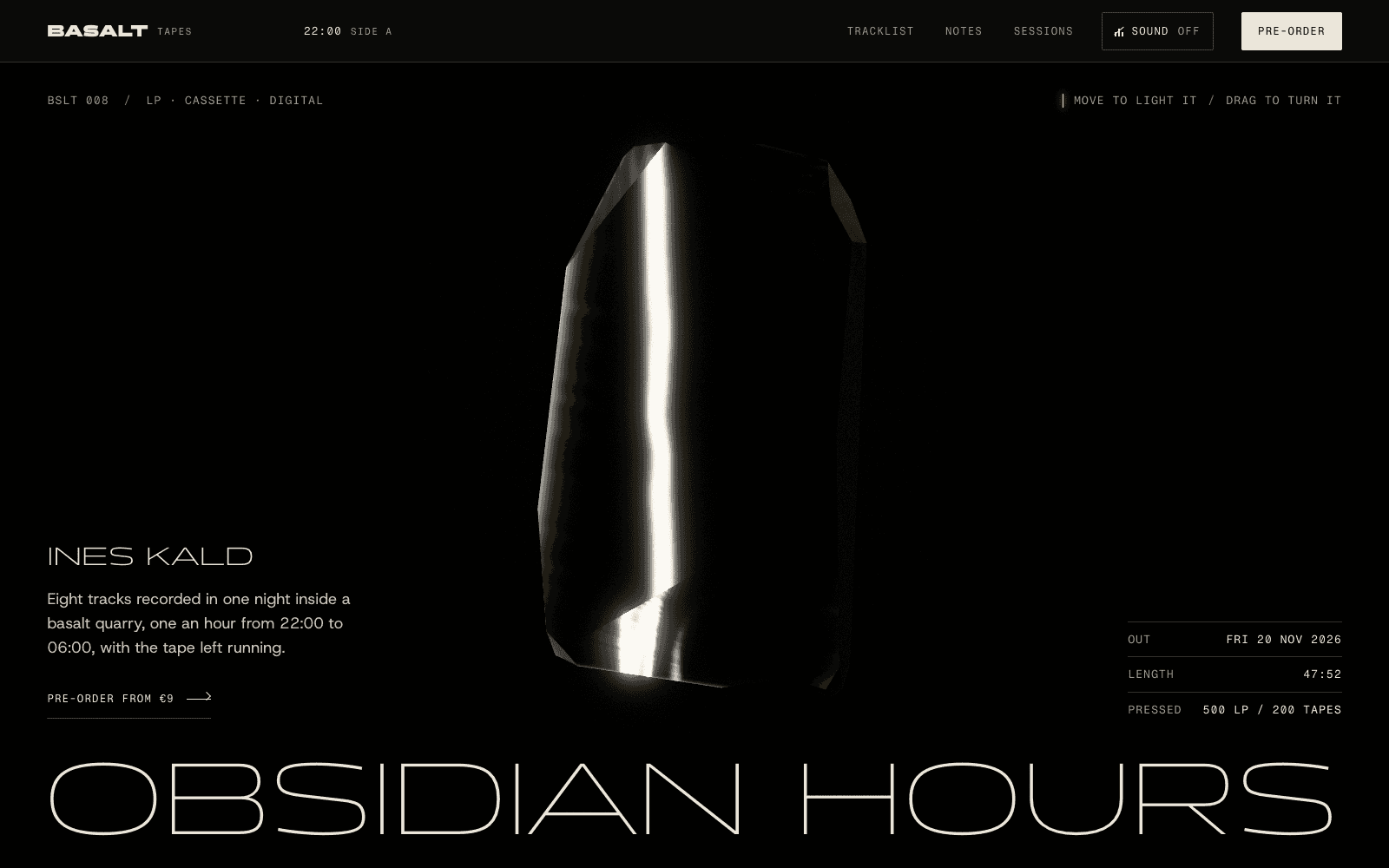
BASALT Tapes is a release page for Obsidian Hours, an eight-track LP by a fictional artist, recorded in one night inside a basalt quarry. The page sells three formats and fills five overnight listening sessions. Everything on it hangs off one object: a slab of black glass you light with your cursor, turn in your hands and break into the record's eight hours.
It is a concept site, made by the Laarpi team with Laarpi's library and process. The label, the artist and the record are invented, and the footer says so.
Obsidian is lava that cooled too fast to form crystals. When you strike it, it breaks in curved rings that spread from the point of impact, the same rings a record shows under a lamp. The record in the story was made the same way the glass was: one night, tape running, no second takes.
So the page uses the glass for everything a release page has to say. The slab is the record. Its eight shards are the tracks. Its fracture rings become grooves. The scroll is the night itself: the clock in the navigation runs from 22:00 at the top of the page to 06:00 at the bottom.
The brief set the audience first: listeners of experimental and ambient records who still buy physical editions, and the label's mailing list. It also listed what to leave out: hero video loops, rows of streaming logos, invented press quotes, neon gradients, card grids for the formats, and any 3D object built from basic shapes.
The slab is a convex polyhedron, fractured in code around one impact point into eight convex shards. A custom shader traces each ray of light through the glass to where it leaves, which gives real refraction with a slight colour split at the edges. The core absorbs light, so it reads black, while thin edges turn smoky. The fracture ripples line up across every break.
There are no images, models or lighting files. The reflections come from a calculated night: a faint sky, black rock and one soft cold light low on the right, so no studio shape ever lands on a facet. The cursor light is a calculated strip light as well. A second object, a vinyl disc, carries the groove scene.
The type does the rest. Panchang at its thinnest weight sets the title as a hairline under the heavy black object, and appears at its heaviest exactly once, as the BASALT wordmark. Host Grotesk carries the reading. Fragment Mono sets hours, durations and catalogue numbers like a label on a specimen drawer. The palette is a black close to the glass, bone for type, ash for data, and one ember orange that means heat and nothing else.
The 3D website examples and interactive website examples show where this sits among our other concept sites. For a page about an artist rather than one record, the music artist website guide covers tour dates, press kits and mailing lists.
Measured on 6 October 2026, cold, with an empty cache, on our phone profile: slow 4G (1.6 Mbps down, 150 ms round trip), CPU slowed four times, a 390 × 844 screen.
| What | Measured |
|---|---|
| First paint, with the "22:00" loader | 0.9 s |
| First frame with the glass drawn | 3.1 s |
| Transferred | 299 KB, 18 requests, one origin |
The page stays light because nothing heavy is downloaded: the glass and its light are maths. Rendering resolution is capped (2× on desktop, 1.5× on touch screens) and drops when frames run long, rendering stops when the glass is off screen or the tab is hidden, and everything is released when you leave. The phone profile slows the CPU but not the graphics chip, so real phones can take longer on the shader work. Fast websites with 3D explains the techniques.
With reduced motion on, there is no smooth scrolling and no scroll-driven break. Each section cuts to a composed still, and all copy is visible from the start. Nothing flashes. The slab turns with arrow keys, every track can be rung from a button, and the sound stays off until you turn it on. Accessible motion covers the same decisions for your own site.
A concept site made by the Laarpi team with Laarpi's library and process. It was not produced end to end by SI, Laarpi's website agent. Sites SI builds on its own carry a "Built by SI" label with their build time and cost.
Third-party pieces, all with licences that allow use on the web:
| Piece | By | Licence |
|---|---|---|
| Panchang | Indian Type Foundry | ITF Free Font License |
| Host Grotesk | Element Type | SIL OFL 1.1 |
| Fragment Mono | Wei Huang, URW Design Studio | SIL OFL 1.1 |
| three.js 0.186.1 | three.js authors | MIT |
| GSAP 3.15.0 | GreenSock | Standard No Charge License |
| Lenis 1.3.26 | darkroom.engineering | MIT |
| Hash without Sine (noise) | Dave Hoskins | MIT |
| PBR Neutral tone mapping | Khronos Group | Apache-2.0 |
The cursor strip light follows Brian Karis's representative-point technique (SIGGRAPH 2013), and the bloom follows Marius Bjørge's dual-filter method (SIGGRAPH 2015), both written fresh for this site.
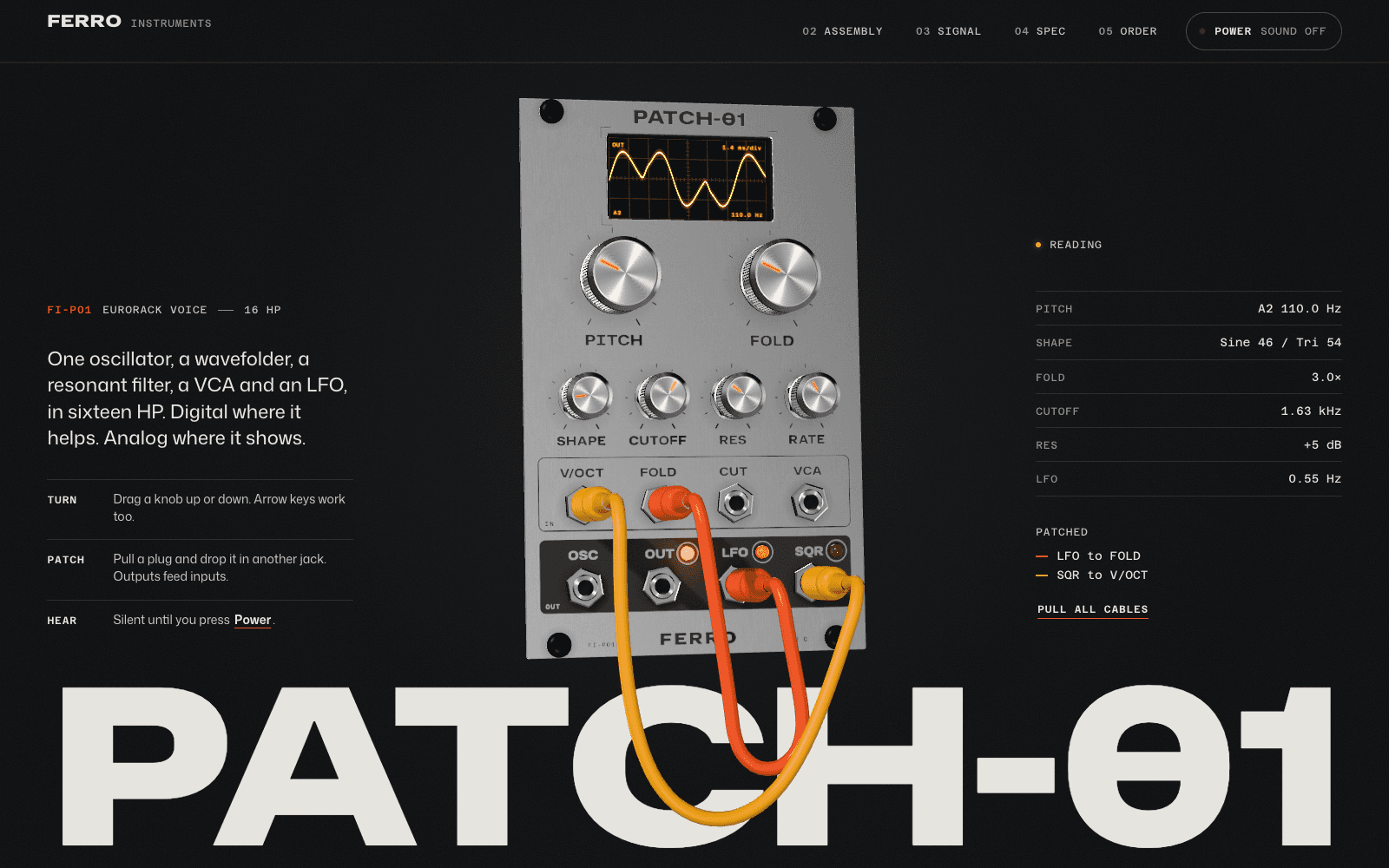
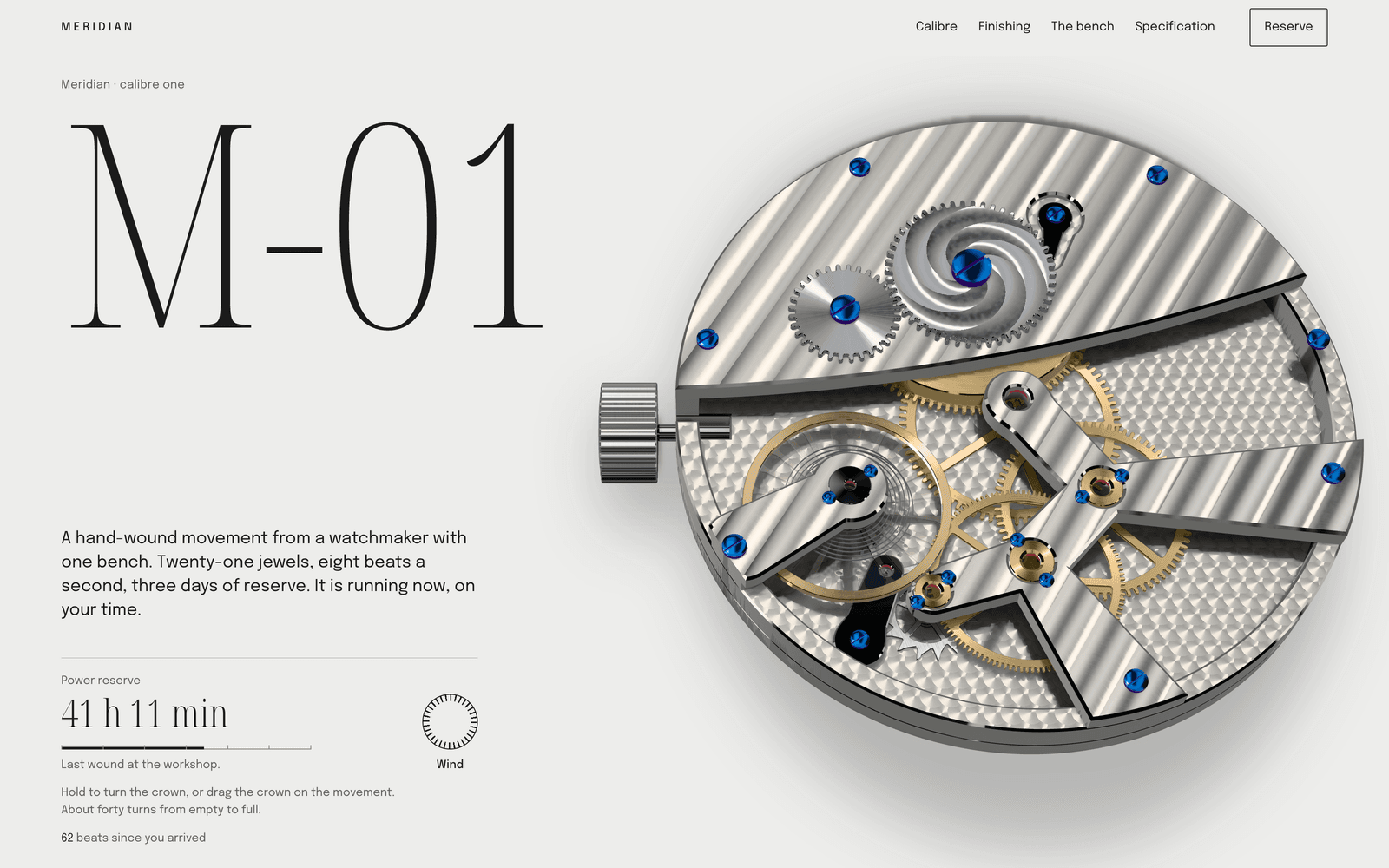
For two more objects you can handle, see PATCH-01, a synth module you can play, and Meridian M-01, a watch movement you can take apart. To start your own release page from this one, remix it.
No. BASALT Tapes, the artist Ines Kald, the Halde quarry and the LP Obsidian Hours are all fictional, and the site says so in its footer. It is a concept site the Laarpi team made to show what a release page can be.
No. The pre-order buttons use Laarpi's Polar checkout module, but no store is connected to this concept, so they are disabled and nothing is sold. On your own site the same buttons open a real checkout once you connect your Polar account.
No. It was made by the Laarpi team with Laarpi's library and process, with people steering every step. Sites that SI builds end to end are labelled "Built by SI" and show their build time and cost.
Neither. The slab, its eight shards and the vinyl disc are generated in code, and the light is calculated rather than loaded from an image. That is why the whole page is about 299 KB on the wire.
Smooth scrolling and the scroll-driven break are switched off. Each section cuts to a composed still of the glass, and all the copy is visible from the start.
Yes. Remix copies the site's code and plan into a project of your own, then you tell the agent what to change. Bring your own artist, record, words and artwork; a remix gives you the design and code, not the fictional label's name.
One fire on an Oregon bluff, sunset to moonrise. Tonight's menu is written in its smoke.
Laarpi Studio
A Eurorack voice you can play in the page: turn it, patch it, take it apart, hear it.
Laarpi Studio
A hand-wound calibre you can wind, take apart under a loupe and watch start again.
Laarpi Studio
A pressed gazania that stands up and blooms only while you hold the cursor still.
Laarpi Studio
Remix this site, or describe a new one. It asks what matters, then designs and builds it from scratch.