Salt & Smoke
One fire on an Oregon bluff, sunset to moonrise. Tonight's menu is written in its smoke.
Laarpi Studio
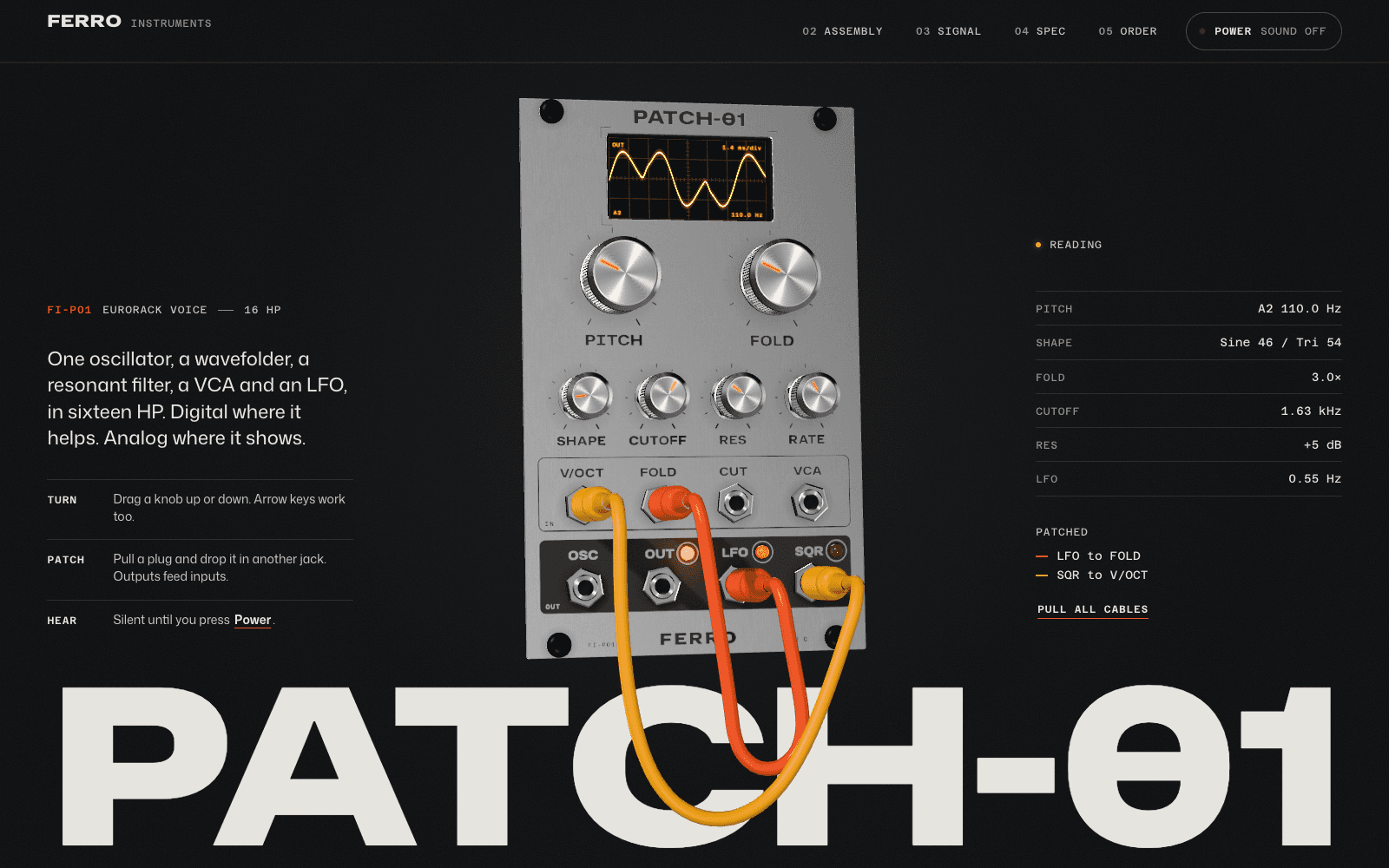
A Eurorack voice you can play in the page: turn it, patch it, take it apart, hear it.
A concept launch page for a fictional Eurorack synth module. The real-time 3D module on the page turns, patches, comes apart along its screws and makes sound, and the patch you make follows you down the page.
PATCH-01 is a launch page for a 16 HP Eurorack voice from Ferro Instruments: one oscillator, a wavefolder, a resonant filter, a VCA and an LFO. The page does not describe the module first. It hands it to you. The real-time 3D module at the top turns, takes cables, comes apart and makes sound, and the patch you make there follows you all the way down to the order form.
It is a concept site, made by the Laarpi team with Laarpi's library and process. The maker and the module are invented, and the footer says so.
People who buy modular synths judge a module by its panel, its knobs and its sound before they read a spec sheet. So the page leads with the thing they judge by. The brief set four goals in this order: let visitors play the module before they read about it, show how it is built and where the signal goes, prove the numbers with a real drawing, then take pre-orders.
The art direction treats the page as a drawing set for a working instrument: product poster, teardown, oscilloscope, datasheet, order form. One rule holds the palette together: orange appears only on things that carry signal, such as cables, knob index lines, the scope trace and the active stage.
The brief also listed what to avoid: synthwave neon, invented testimonials or artist logos, stock studio photos, icon-card feature grids, and any sound before the visitor presses Power.
The module is modelled in code at true millimetre scale: lathe-turned knobs with a diamond-knurl pattern, hex nuts, threaded bushings, LEDs, a glass-covered scope, two populated circuit boards and a red-stripe power ribbon. The panel legends are engraved from the page's own fonts. One three.js renderer draws the whole page, and the module is framed into boxes in the layout so it never runs under the copy.
The light is a CC0 studio HDRI from Poly Haven, graded at runtime into a black studio, plus light cards. The brushed streaks on the aluminium come from a CC0 ambientCG metal material, packed into a single image. Bloom is limited to things that glow, such as LEDs and the scope.
The spec drawing is not an illustration. It is rendered as SVG from the same layout file that places every knob and jack on the 3D panel, so the drawing and the model cannot disagree.
The type follows the engineering idea. Hubot Sans, wide and heavy, fills the viewport with the PATCH-01 wordmark. Mona Sans sets the copy, and Azeret Mono carries every number and readout with tabular figures, like an instrument display.
For what makes a launch page sell, see a launch page that converts and the product launch page use case. The interactive website examples, product website examples and 3D website examples collect it with our other concept sites.
Measured on 6 October 2026, cold, with an empty cache, on our phone profile: slow 4G (1.6 Mbps down, 150 ms round trip), CPU slowed four times, a 390 × 844 screen.
| What | Measured |
|---|---|
| First paint, with the "Power-on" loader | 0.9 s |
| First frame with the module fully drawn | 7.8 s |
| Transferred | 933 KB, 27 requests, one origin |
A loading pass on the same day halved both figures: the module was taking 15.7 s on this profile and transferring 1.99 MB from four origins. The loader shows real progress from the first paint, so the wait is never a blank screen. Rendering resolution is capped (2× on desktop, 1.5× on touch screens) and drops when frames run long, and rendering pauses when the module is hidden or covered. The phone profile slows the CPU but not the graphics chip, so real phones can take longer. Fast websites with 3D covers the techniques.
With reduced motion on, there is no smooth scrolling and there are no camera flights: each section holds a composed, still state, the LEDs stay steady and the cables hang settled. The knobs are slider controls over the render, so they take arrow keys and Page Up and Page Down. The jacks are buttons: Enter or Space picks up a cable and plugs it in, and a live region announces each change to screen readers. Sound never starts until you press Power. More in accessible motion.
A concept site made by the Laarpi team with Laarpi's library and process. It was not produced end to end by SI, Laarpi's website agent. Sites SI builds on its own carry a "Built by SI" label with their build time and cost.
| Piece | By | Licence |
|---|---|---|
| Monochrome Studio 02 (HDRI) | Grzegorz Wronkowski, Poly Haven | CC0 |
| Metal 009 | ambientCG (Lennart Demes) | CC0 |
| Hubot Sans, Mona Sans | GitHub | SIL OFL 1.1 |
| Azeret Mono | Displaay Type Foundry | SIL OFL 1.1 |
| three.js 0.186.1 | three.js authors | MIT |
| GSAP 3.15.0 | GreenSock | Standard No Charge License |
| Lenis 1.3.26 | darkroom.engineering | MIT |
| PBR Neutral tone mapping | Khronos Group | Apache-2.0 |
The module's geometry, panel engraving, circuit-board artwork, cables, voice, scope and figure shaders are original code written for this site.
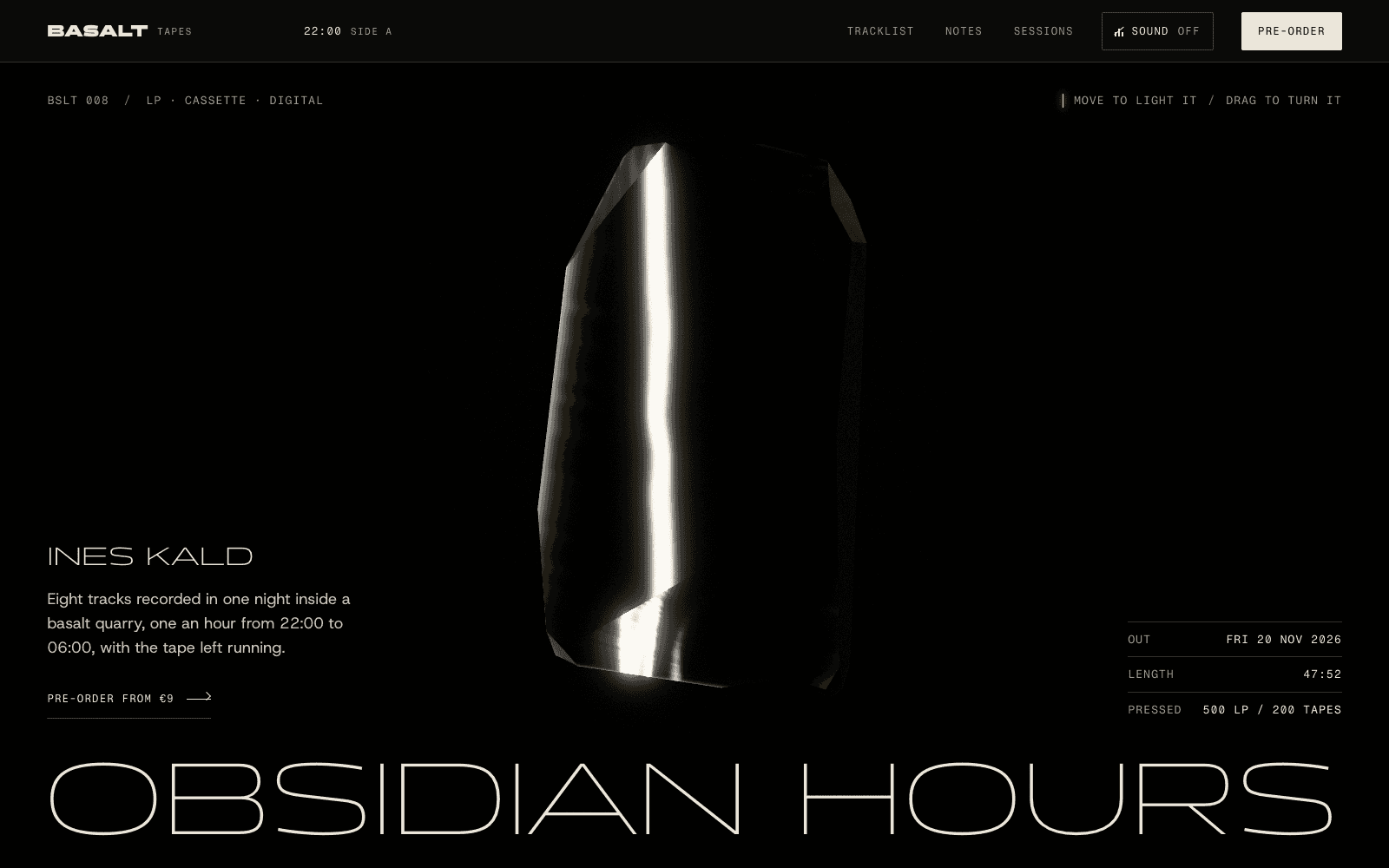
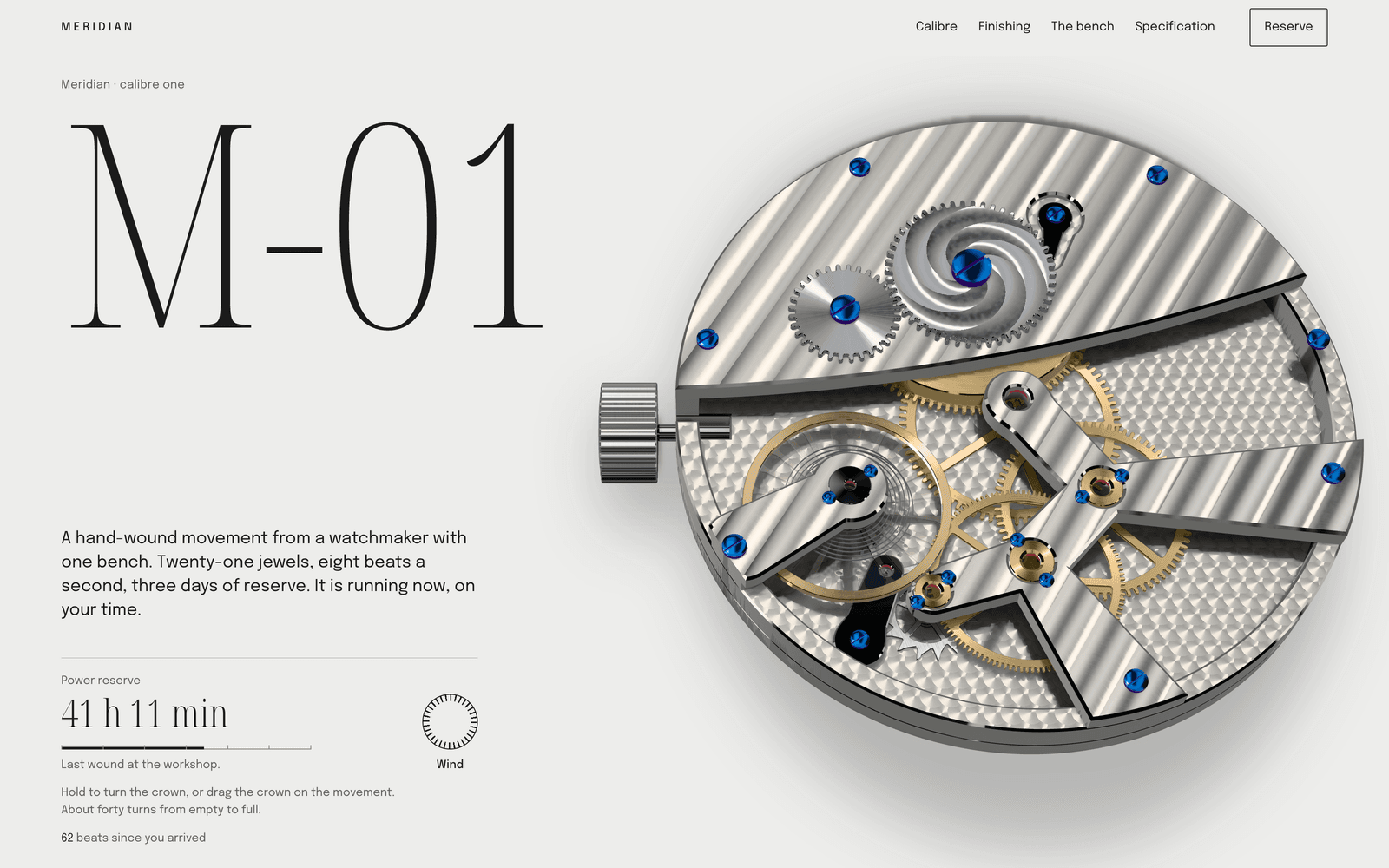
For two more objects you can handle, see Meridian M-01, a watch movement you can wind and take apart, and BASALT Tapes, a glass record you can light and break. To start your own product page from this one, remix it.
No. Ferro Instruments and PATCH-01 are fictional, and the footer says so. The sound is real, though: the voice runs in your browser with the Web Audio API, so the module on the page plays.
No. The pre-order button uses Laarpi's Polar checkout module, but no store is connected to this concept, so the button is disabled and nothing is sold. On your own site the same button opens a real checkout once you connect your Polar account.
On purpose. Nothing plays until you press Power, so the page never surprises you with sound in a quiet room or on a train.
No. It was made by the Laarpi team with Laarpi's library and process, with people steering every step. Sites that SI builds end to end are labelled "Built by SI" and show their build time and cost.
Yes. The knobs take arrow keys and Page Up and Page Down. The jacks are buttons: press Enter or Space on an output to pick up a cable and again on an input to plug it in, and a screen reader hears what was patched.
Yes, as a starting point. Remix copies the site's code and plan into your own project, and you tell the agent what to change. A real product needs its real dimensions and specification, which you provide; Laarpi does not invent them.

One fire on an Oregon bluff, sunset to moonrise. Tonight's menu is written in its smoke.
Laarpi Studio
A hand-wound calibre you can wind, take apart under a loupe and watch start again.
Laarpi Studio
A pressed gazania that stands up and blooms only while you hold the cursor still.
Laarpi Studio
Scroll to the floor of the Kermadec Trench. Below 1,000 m your cursor is the lamp.
Laarpi Studio
Remix this site, or describe a new one. It asks what matters, then designs and builds it from scratch.