Salt & Smoke
One fire on an Oregon bluff, sunset to moonrise. Tonight's menu is written in its smoke.
Laarpi Studio
A pressed gazania that stands up and blooms only while you hold the cursor still.
A concept site for a fictional night-garden exhibition at a botanical archive. A real scanned gazania lies pressed on a herbarium sheet and stands up to bloom only while the visitor holds still.
Hortus Nocturne is the website of a night-garden exhibition: for one summer, a botanical archive stays open after dark to show eight plants that flower only at night. The page has to do what any exhibition site does, with dates, a route, opening hours, access and tickets. Before any of that, it shows you what it is like to watch a flower open.
It is a concept site, made by the Laarpi team with Laarpi's library and process. The archive and the exhibition are invented, and the footer says so. The plant is real.
The brief's big idea is six words: flowers that only bloom while you look at them. A herbarium keeps flowers pressed flat forever. On this page one pressed specimen, herbarium sheet 0417, stands up and blooms only while you hold still over it, and lies back down when you look away. Attention is the light.
The audience was set first: garden lovers, night owls and design-minded visitors deciding whether to book an evening. The voice was specific, dry and botanical. The brief also listed what to leave out: plants built from basic shapes, stock garden photography, invented reviews or visitor numbers, purple-to-blue gradients, three-card feature grids, and gimmicky readouts over the 3D.
So the page opens on a walnut reading-room table in moonlight, with glazing bars across the paper and a gazania pressed flat on the sheet. The rest of the site reads like the archive's own records: an accession ledger, a garden plan, a timetable of night tours, tickets set as a ledger.
The flower is a photoscanned gazania from Poly Haven, released under CC0. The trick is in how it is posed. Every part of a scanned model has a flat UV island, the outline its texture was unwrapped into, and that outline is exactly the shape the part would take pressed on paper. So the pressed pose is derived from the scan's own UV islands at runtime, and waking is each part rotating from that flat outline into its living pose, staggered from stem to leaf to flower, with the scan's own bend added back.
Two lights do the storytelling. A cold moonlight spot casts the window's glazing bars across the table. A warm firefly lantern carries real shadows, and the petals let its light through. A colour grade modelled on the Purkinje shift, the way human eyes lose red in dim light, drains colour from anything the fireflies are not lighting. That is why the orange of the gazania appears only where your light falls.
The eight flower drawings and the garden plan are generated line art, not illustrations. The botanical names were checked against GBIF's backbone taxonomy, and the full-moon dates that open and close the season were computed with Meeus' algorithm.
The type is set like a herbarium label. Bodoni Moda, a revival of the Didone faces of the years when Thornton published The Temple of Flora, takes the display lines and the italic Latin names. Crimson Pro is the reading face. Courier Prime sets accession numbers and times the way an archive typewriter would. The palette is midnight green, moon-bone and lichen, with pollen yellow kept for what is alive: fireflies, the route, the drawings and the calls to action. If that plate-label-ledger logic suits your own collection, the Botanical Archive style is the closest direction in Laarpi's library.
The interactive website examples show where this sits among our other concept sites. For a real exhibition, festival or opening, the event website guide covers dates, tickets and practical information.
Measured on 6 October 2026, cold, with an empty cache, on our phone profile: slow 4G (1.6 Mbps down, 150 ms round trip), CPU slowed four times, a 390 × 844 screen.
| What | Measured |
|---|---|
| First paint | 2.0 s |
| Loader on screen | 1.9 s |
| First frame with the plant drawn | 13.1 s |
| Transferred | 1,979 KB, 25 requests, one origin |
This is the heaviest of our concept sites on a slow connection, and the reason is simple: the specimen is a real scan. The model is about 1.1 MB after compression, and the paper and walnut textures add about 400 KB more. On this profile that download alone takes several seconds.
The loader makes the wait part of the idea. It is called "Gathering": fireflies drift in over the outline of sheet 0417, one for each fortieth of the real progress, and when the scene is ready they land exactly where it draws the sheet. Before this pass, the page took 16.4 seconds on the same profile, pulled 2,347 KB from four origins, and had a main-thread task of 2.5 seconds; now everything comes from one origin and the textures are decoded off the main thread. Rendering resolution is capped (1.75× on desktop, 1.5× on touch screens), steps down once on slow frames, pauses off screen and in hidden tabs, and everything is released when you leave. Fast websites with 3D explains the trade-offs, including when a real scan is worth its weight.
With reduced motion on, there is no smooth scrolling. The specimen appears as a composed still, already awake, the flower drawings appear instantly, and the route is drawn in full. The fireflies pulse at under one cycle per second, and nothing flashes. The ledger rows are buttons, so the flower drawings respond to keyboard focus as well as pointer and touch. Waking the specimen needs a pointer or a held touch; it decorates the page rather than carrying information, and everything it shows is also in the copy. Accessible motion covers these decisions for your own site.
A concept site made by the Laarpi team with Laarpi's library and process. It was not produced end to end by SI, Laarpi's website agent. Sites SI builds on its own carry a "Built by SI" label with their build time and cost.
Third-party pieces, all free for commercial use:
| Piece | By | Licence |
|---|---|---|
| Flower Gazania (photoscan) | Jenelle van Heerden, James Ray Cock, Poly Haven | CC0 |
| Black Walnut Veneer 02 | Jenelle van Heerden, Poly Haven | CC0 |
| Paper 001 | ambientCG | CC0 |
| Bodoni Moda | Owen Earl | SIL OFL 1.1 |
| Crimson Pro | Jacques Le Bailly | SIL OFL 1.1 |
| Courier Prime | Alan Dague-Greene | SIL OFL 1.1 |
| three.js r186.1 | three.js authors | MIT |
| GSAP 3.15.0 | GreenSock | Standard No Charge License |
| Lenis 1.3.26 | darkroom.engineering | MIT |
The specimen's pressed pose and waking, the fireflies, the loader, the moonlight window, the colour grade, the eight drawings, the garden plan and all copy are original to this site.
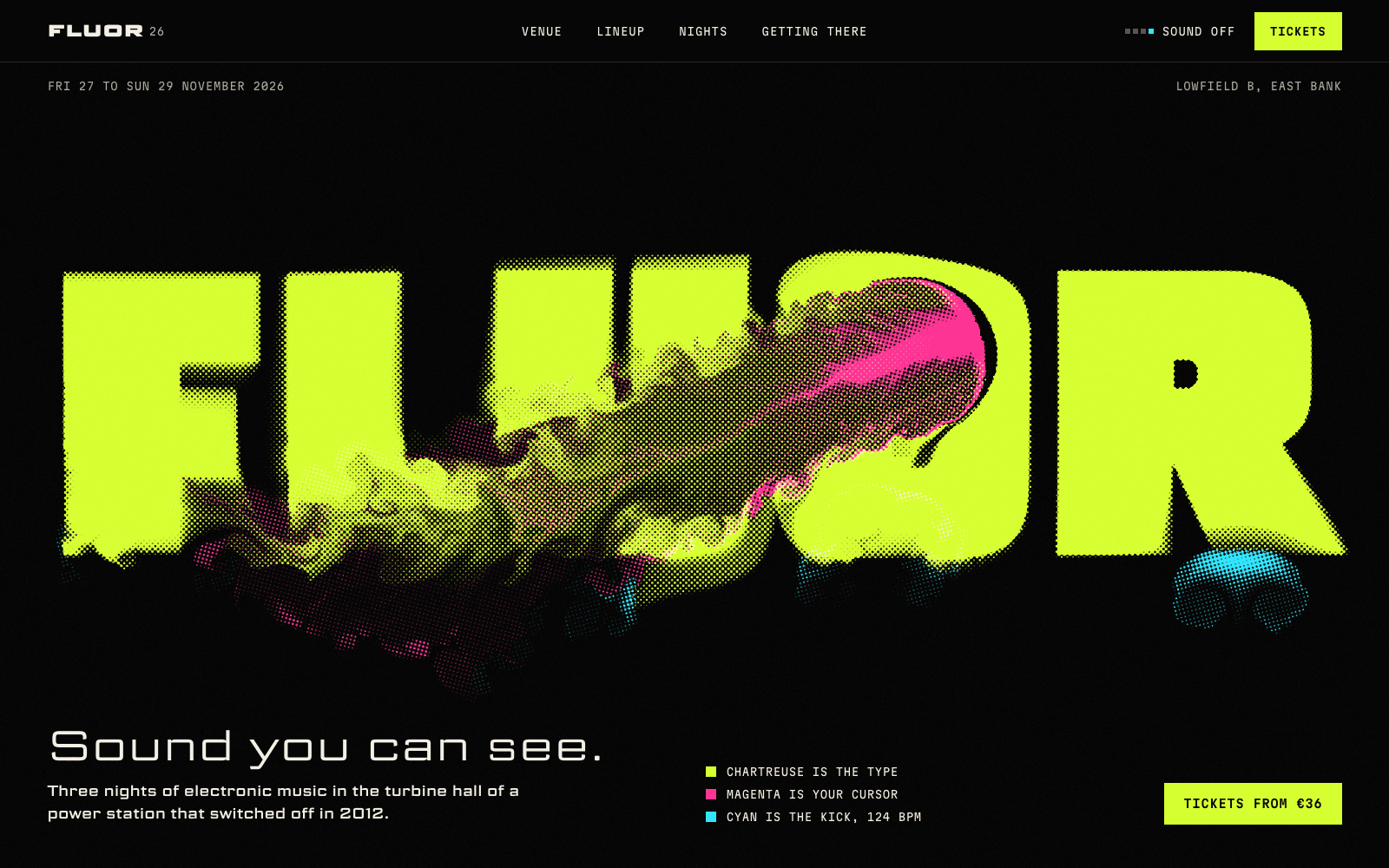
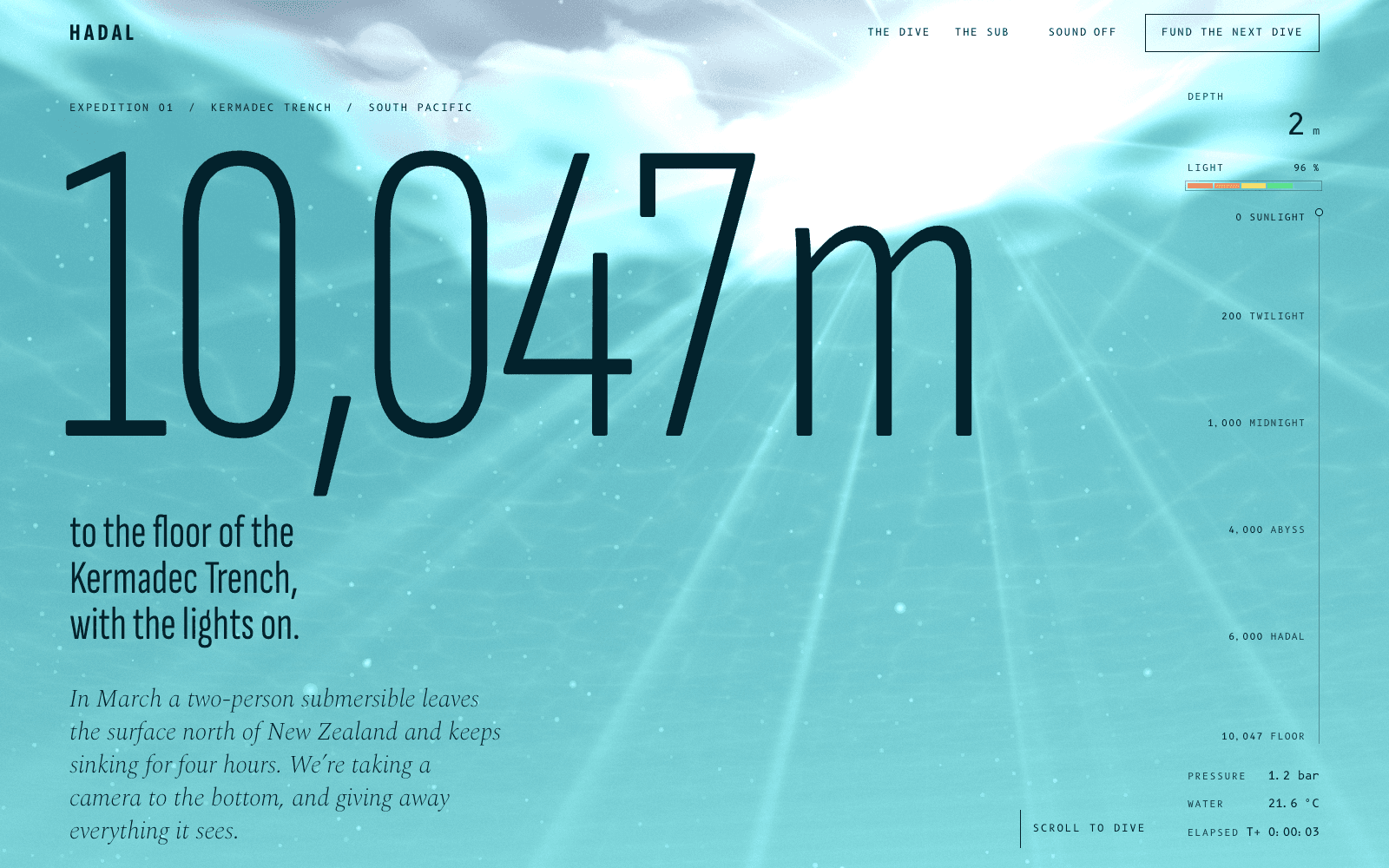
For two more places told through light, see HADAL, a dive where your cursor is the lamp, and FLUOR 26, a festival printed in ink you can stir. To start your own exhibition site from this one, remix it.
No. The exhibition and the Hollowmere Botanical Archive are fictional, and the footer says so. The plant on sheet 0417 is real: a CC0 photoscan of a gazania from Poly Haven. It is a concept site the Laarpi team made to show what an exhibition site can do.
No. The three ticket buttons use Laarpi's Polar checkout module, but no account is connected to this concept, so they are disabled and nothing is sold. On your own site the same buttons open a real checkout once you connect your Polar account.
No. It was made by the Laarpi team with Laarpi's library and process, with people steering every step. Sites that SI builds end to end are labelled "Built by SI" and show their build time and cost.
Touch and hold the sheet. The fireflies gather under your finger and the plant stands up for as long as you keep it there. Lift your finger and it lies back down.
Because the flower is a real scan. The scanned model alone is about 1.1 MB, and on our slow phone profile the first frame with the plant drawn arrived at 13.1 seconds, with a loader on screen from 1.9 seconds. On a faster connection it is far quicker. A real scan was the point of this site, and we chose it knowing the cost.
Yes. Remix copies the site's code and plan into a project of your own, and you tell the agent what to change. Bring your own venue, dates, objects and words; a remix gives you the design and code, not the fictional archive.

One fire on an Oregon bluff, sunset to moonrise. Tonight's menu is written in its smoke.
Laarpi Studio
A Eurorack voice you can play in the page: turn it, patch it, take it apart, hear it.
Laarpi Studio
A hand-wound calibre you can wind, take apart under a loupe and watch start again.
Laarpi Studio
Scroll to the floor of the Kermadec Trench. Below 1,000 m your cursor is the lamp.
Laarpi Studio
Remix this site, or describe a new one. It asks what matters, then designs and builds it from scratch.