A Dora alternative for 3D websites
Dora's verified status, and fair options for building 3D and animated sites now: what each tool does, what it costs and who it suits.
Dora appears to be offline, and has been since spring 2026. If you built with Dora, or came looking for it to make a 3D or scroll-animated site, this page sets out what we could verify about its status and the tools that cover the same ground now. For how Laarpi handles 3D specifically, see the 3D website builder; the rest of this page is a fair look at all the options, Laarpi included.
Dora's status, with the evidence
These are the facts we could check ourselves, with dates. We are not speculating about why.
| Check | Result | Date |
|---|---|---|
| DNS lookup of dora.run via Google Public DNS | NXDOMAIN (the name no longer resolves) | 4 October 2026 |
| DNS lookup via Cloudflare (1.1.1.1), Google (8.8.8.8) and Quad9 (9.9.9.9) | NXDOMAIN from all three; the name points to a hosting address that no longer exists | 5 October 2026 (UTC) |
Opening https://dora.run in a browser and from the command line | No connection | 5 October 2026 (UTC) |
| Tool Directory's Dora listing | "Shut down" on 1 May 2026; page last reviewed 8 August 2026 | Read 6 October 2026 |
| An official shutdown notice from Dora | None found | 6 October 2026 |
Several AI tool directories still describe Dora as live. Their pages appear not to have been updated. You can repeat the DNS check yourself with the Google Public DNS link in this page's sources: a "Status" of 3 means NXDOMAIN.
If Dora comes back, we will update this page and say so at the top.
What Dora users came for
Dora was one of the few builders people found when they searched for 3D, animated or scroll-driven websites. Directory listings describe it as a no-code builder for sites with 3D and animation, with a mode that generated a site from a text prompt. Whatever you used it for, the job usually breaks down into three needs:
- A 3D or animated moment that makes the site memorable: an object that turns, a scene that responds to scroll or cursor.
- No code, or very little.
- A published site, on a domain, without stitching tools together.
No single option on this page is best at all three for everyone. The table shows where each one sits.
The options, side by side
Facts are from each tool's own pages, checked on 6 October 2026. Prices are the published entry prices in US dollars; check the sources before you buy, because plans change.
| Tool | What it is | 3D and motion | Publishes a whole site? | Free plan | Paid from |
|---|---|---|---|---|---|
| Spline | A 3D design tool in the browser | Model, light and animate 3D scenes visually; add interactions | No: you export or embed scenes into a site built elsewhere | Yes, with watermarked web exports | Hobby, $12 a month billed yearly ($15 monthly) |
| Unicorn Studio | A visual tool for WebGL effects | 75+ configurable effects: shaders, media, 3D, interactive motion | No: you embed scenes in Framer, Webflow, Figma Sites, React or HTML | Yes, up to 8 publishes with its branding, personal use | Legend, $20 a month or $168 a year |
| Framer | A visual site builder with an AI agent, CMS and hosting | Effects and animation on the canvas; real-time 3D through code components or embeds | Yes, on Framer hosting | Yes, on a Framer domain | Basic, $10 a month per site billed yearly |
| Webflow | A visual site builder with CMS and hosting | Interactions with GSAP on every plan at no extra cost; native Spline scenes you can animate in GSAP timelines | Yes, on Webflow hosting | See its pricing page | See its pricing page (plans changed in May 2026) |
| Laarpi (private beta) | A website agent, SI, that builds from a description | three.js scenes planned into the brief, with a still version for reduced motion | Yes, on a laarpi.site address or your own domain on paid plans | Yes: 30 credits a month, up to 3 projects | Pro, $25 a month |
The order is alphabetical, with Laarpi last. We have not run a side-by-side test of these tools, so this page makes no claim about which produces the best site.
Spline: design the 3D scene yourself
Spline is where many designers make the 3D object in the first place. You model, light, texture and animate in the browser, add interactions and events, then export the scene as a web embed or code and place it in a site. Spline's free plan includes web exports with a watermark; paid plans remove it, and code download sits on the Max plan.
Pick it if you want hands-on control of the 3D itself and already have, or are happy to use, a separate site builder. Webflow, for one, has a native Spline integration.
Unicorn Studio: effects for a site you already have
Unicorn Studio is a visual canvas for WebGL effects: shaders, image distortion, 3D and interactive motion, from a library of more than 75 configurable effects. You publish a scene and paste a ready-made component into Framer, Webflow, Figma Sites, React or plain HTML. The free plan allows up to 8 publishes with Unicorn branding for personal use; the Legend plan adds unlimited unbranded publishes and a commercial licence.
Pick it if you already have a site and want a striking hero or background effect without writing shaders.
Framer: a whole site on a visual canvas
Framer is a complete site builder: a design canvas, an AI agent that creates and edits pages from a description, a CMS and managed hosting. Motion and effects are set up visually; real-time 3D comes through code components, which its agent can build, or embeds. One thing to know before you commit after losing a Dora site: Framer's help centre says it does not offer HTML export for self-hosting.
Pick it if you want to design every element yourself and keep the whole site, CMS included, in one hosted tool. We compare it with Laarpi in detail in Laarpi vs Framer.
Webflow: visual building with serious motion
Webflow is a visual builder with a CMS and hosting. Its Interactions are built on GSAP, a widely used animation library, and are available on every plan at no extra cost. Since 28 January 2026, Spline scenes pasted into Webflow can be animated directly in those GSAP timelines, which makes Webflow plus Spline a capable no-code route to scroll-driven 3D.
Pick it if you want precise control of scroll animation and expect to grow into a CMS-driven site, and you don't mind a steeper learning curve than a prompt.
Laarpi: describe the site, and the 3D is part of the design
Laarpi is in private beta. You describe the site; Laarpi's agent, SI, asks the few questions that matter, writes a brief you can edit (concept, palette, type, sections and motion), then builds the site live. When the idea calls for 3D, the brief says what the scene is and how it answers scroll and cursor, and SI writes it in three.js: lit with open-source HDR environments, using credited open-source models for real objects, with rendering capped on phones and a composed still version for visitors who turn motion off. You direct the result in words or by pointing at the page, then publish.
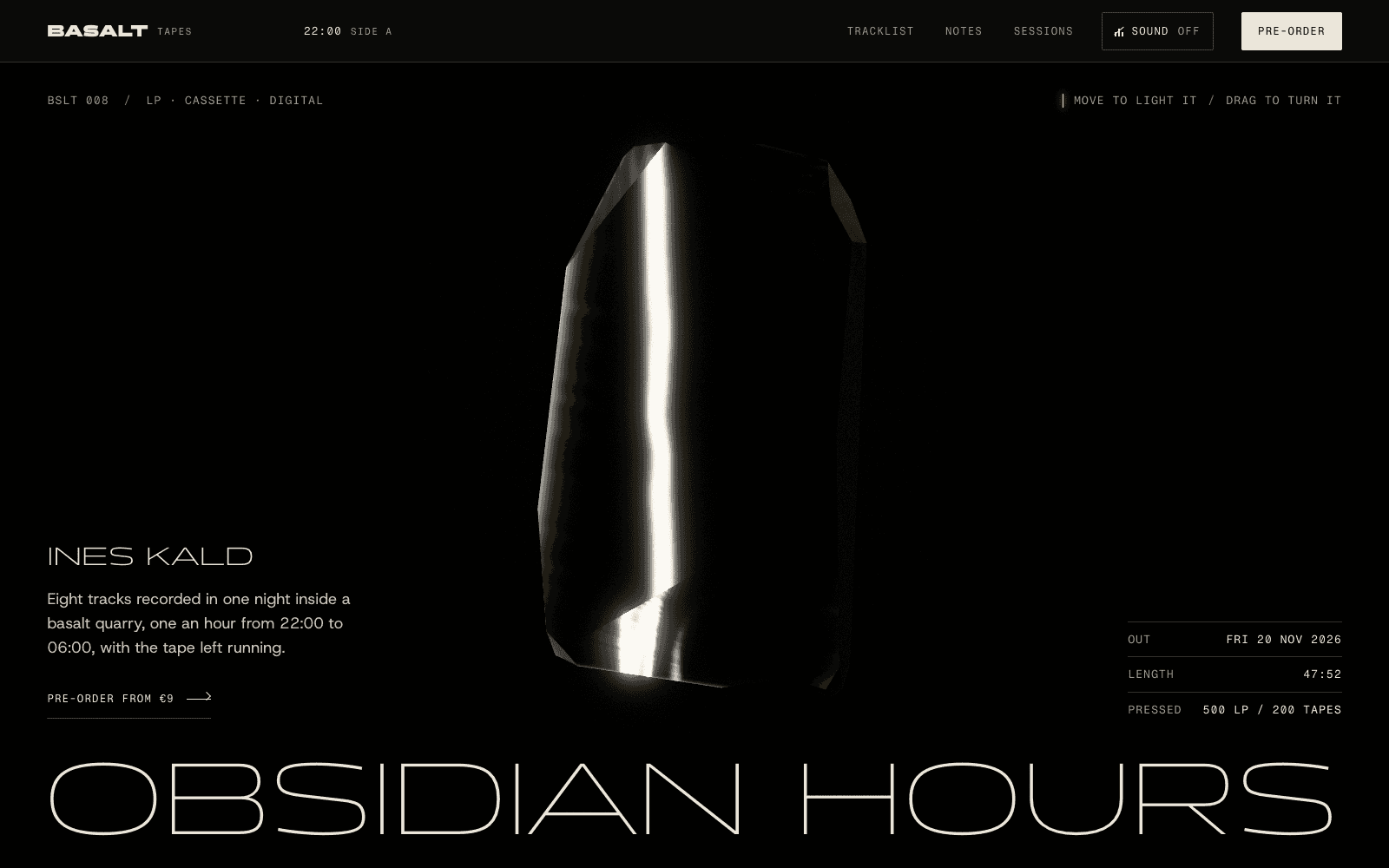
BASALT Tapes is a concept release page for an invented record label: an obsidian slab you light with the cursor breaks into the record's eight tracks as you scroll. On our throttled phone profile (slow 4G, CPU slowed four times) its first full frame arrived in 3.1 seconds, at 299 KB. Like every showcase site, it was made by the Laarpi team with Laarpi's library and process, with people steering every step, not produced end to end by SI. More of them, with load times, are on 3D website examples.
What Laarpi doesn't do today: it has no importer, it can't open a web address, and downloading a site's code is planned rather than available. Attaching photos, documents and logos that SI places on the site is in development.
Pick it if you would rather describe the site than build it by hand, and the 3D is the point of the site rather than an add-on.
Moving on from a Dora site
With dora.run offline, there is no export to run. Rebuilding is the path, and it goes faster with the right material in hand.
Gather what you have:
- Copy: headlines, body text, product descriptions. Check old emails, documents and the Internet Archive's Wayback Machine, if it captured your pages.
- Images and video in their original files, not screenshots of them.
- 3D models you made or licensed. glTF and GLB are the most portable formats for the web.
- Brand basics: colours, fonts and logo files.
- The feel: screenshots or a screen recording of the old site, and a sentence on what the 3D moment did.
Then rebuild:
- In Spline, recreate the 3D scene, then embed it in Framer, Webflow or your own code.
- In Framer or Webflow, rebuild the pages on the canvas and bring the 3D in through Spline, Unicorn Studio, embeds or code.
- In Laarpi, describe the site and the 3D moment in a few sentences, paste the copy and attach the screenshots as references. SI designs a new site from them rather than copying the old layout.
Keep your domain. If you pointed a domain of your own at Dora, the domain is still yours at your registrar. Point its DNS at the new host when the new site is ready.
Plan for phones. 3D that felt fine on a desktop can be slow on a mid-range phone. Our guide to website performance with 3D has measured numbers and the fixes that matter, and how to build a 3D website covers both the embed route and building around 3D.
Weighing broader options? The compare hub has Laarpi next to Framer, Webflow, Wix, Squarespace, Lovable, Bolt and v0.
Sources
Checked October 2026. Plans and features change; the linked pages are the authority.
- Google Public DNS lookup for dora.run (returns NXDOMAIN, Status 3, as of 5 October 2026 UTC)
- Tool Directory: Dora AI, listed as shut down on 1 May 2026 (last reviewed 8 August 2026)
- Spline pricing, checked 6 October 2026
- Unicorn Studio pricing, checked 6 October 2026
- Framer pricing (yearly billing), checked 6 October 2026
- Framer Help: HTML export and self-hosting
- Webflow: Interactions with GSAP
- Webflow: Spline action in Interactions with GSAP (28 January 2026)
- Webflow pricing